Objectives
The “Global Development and Governance” program is for those committed to being top leaders in sustainable development and governance. Taught in English, with a focus on problem-based learning, the course is interdisciplinary, cross-sectoral, and multi-regional and informed by evaluation of the UN Sustainable Development Goals. Students will address the world’s ‘wicked problems’, from global inequality to just transition, from hegemony to delayed development, from people-trafficking to AI, from famine to the pandemic of obesity and more, with the aim of developing innovative solutions. They will be provided with the necessary methodologies to analyze real-world problems and critically evaluate policy responses drawing on core disciplines, comparative policy analysis and intercultural communication. Backed by two years of rigorous classroom and field learning, graduates will be equipped immediately to contribute to the work of government agencies, international organizations, and private sector entities involved in national, regional, or global development.
Program Highlights and Advantages
-
1. The United Nations Sustainable Development Goals offer a shared policy framework, its successes and failures providing the degree program with the problem-based evidence used to address global and regional development and governance issues.
-
2. Moving beyond traditional disciplinary boundaries, the program nurtures cultural literacy, fostering an approach that integrates perspectives from social science scientific reasoning, and engineering technology to analyze and devise innovative solutions for economic, social, and environmental issues.
-
3. Drawing on Stanford University's approach to cultivating applied talents, we adopt the P6BL model for teaching:
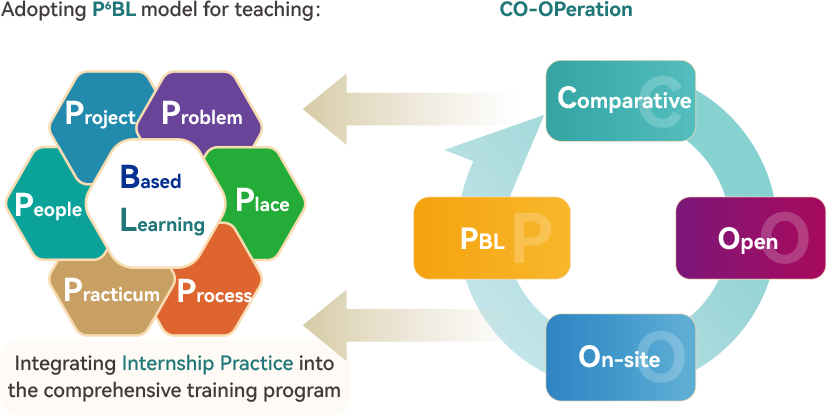
Educational System
The master’s program in “Global Development and Governance” is taught in English- and entails two-year of full-time study. It combines classroom-based learning and project work with practical professional experience gained from internships in international organizations and related institutions. Graduation from the Academy requires the successful accumulation of the required course credits together with presenting and orally defending a thesis based on original work.
Curriculum
The degree program is developmental and cumulative initially providing a grounding in the Chinese language and culture. It then introduces the theories and methods of global development, the foundations of international regulation and policy management and the principles of innovative design and intercultural communication. Students are then offered a wide range of elective courses relating to policy areas and concerns associated with the achievement and further development of the 17 Sustainable Development Goals
| Course Category | Course Name | Credit | Hours | Semester |
|---|---|---|---|---|
|
General Compulsory Courses
(6 credits)
|
Theory and Practice of Socialism with Chinese Characteristics for a New Era | 3 | 48 | Autumn |
| English for Masters of Global Development & Governance | 3 | 48 | Autumn | |
| Chinese | 3 | 48 | Autumn | |
| Introduction to Contemporary Development of China | 3 | 48 | Autumn | |
|
Professional Compulsory Courses
(14 credits)
|
Introduction to Global Development and Governance | 3 | 48 | Autumn |
| Evidencing Global Development and Governance: Qualitative and Quantitative Research Methods | 3 | 48 | Autumn | |
| Regulatory Compliance in Global Governance | 2 | 32 | Spring | |
| Innovative Design and Communication | 2 | 32 | Spring | |
| From Ideas to Practice: Achieving Results through Project Leadership and Management | 2 | 32 | Spring | |
| Intercultural Communication | 2 | 32 | Autumn | |
|
Professional Elective Courses
(9 credits)
|
Poverty Alleviation and Development | 3 | 48 | Spring |
| Social Policy: From a Comparative and Global Perspective | 3 | 48 | Spring | |
| International Education and Global Development | 3 | 48 | Spring | |
| Economic Issues in Sustainable Development | 3 | 48 | Spring | |
| Social Policy: From a Comparative and Global Perspective | 3 | 48 | Spring | |
| Innovation, Digitalization and Intelligentization | 3 | 48 | Spring | |
| Global Climate Change: Impacts and Responses | 3 | 48 | Spring | |
|
Compulsory Section
(10 credits)
|
Professional Internship | 4 | / | Autumn |
| Oualification Assessment | 1 | / | Autumn | |
| Research and Academic Activities | 1 | / | / | |
| Thesis Project | 4 | / | / | |
|
Field Expansion
|
Other Public Elective Courses (if needed) | Non-Credit | / | / |

Scan the QR code
to follow our WeChat official account